Tuesday, February 15, 2011

Meal for a Blizzard

Pickle soup made with onion, carrot, celery, brine from homemade dills, minced dill pickles from the Polish grocery, some frozen pork stock I made a while back, water, dill and cream.  Garnished with more dill to serve.


Elk steaks generously crusted with coarse ground peppercorns and seared on the pan.
Pan sauce with cognac, cream, onions (no shallots around unfortunately), mustard and butter.
Garnished with chopped parsley and served with some old pickled oyster mushrooms originally picked in NY.  These steaks are a treat.
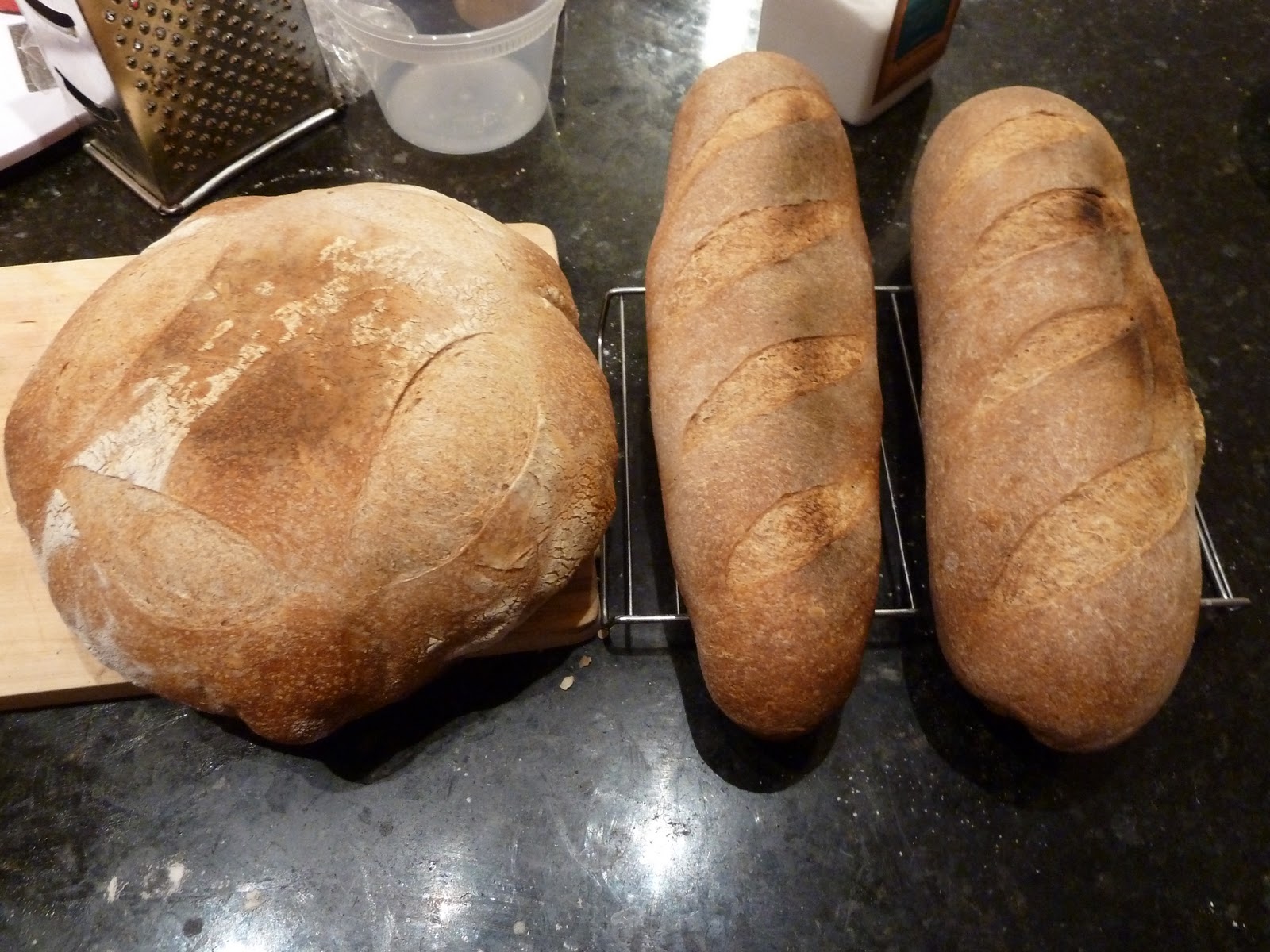
I baked the buckwheat batards and the other bread in the last post on the same day, and that was served with  this meal.

Thursday, February 3, 2011

Bread Part Two

These breads are all from Daniel Leader's Local Breads, which has a ton of great anecdotes and really interesting breads which I can't wait to try.  I need to source some good rye flour.

The first bread I tried from the book was a basic pain au levain, what Leader calls the "quintessential French sourdough."  The recipe calls for 6% rye flour, 24% stone ground whole wheat and 70% bread flour.  I just did 70/30 bread flour and whole wheat flour in the absence of rye.  Leader doesn't call for retarding the dough in the fridge overnight (French sourdough has very little sourness, and longer fermentation causes more acid to be produced by the lactobacillus bacteria in the sourdough), but I did anyway, mostly because of timing issues.

I can thank Leader for the tip about wetting the lame before scoring.  Here it is:
And the batards, ready for the oven.  I think they could have proofed a bit longer, but it was already midnight.  Parchment paper is very convenient.
 In the oven:
 There's the oven spring.  You can see the batard on the left already rupturing.
 And the finished bread.
 Beautiful crust.

There are a bunch of awesome looking rye breads in the book, but I still don't have any rye flour.  In the meantime, buckwheat batards caught my eye.  The bread is based on an original loaf made by Eric Kayser at his Paris boulangerie called the Paline.  I don't think I had ever had buckwheat bread, though I really like soba and galettes - both of which I would like to try to make.  Also, if anyone wants to buy me some caviar, I'll bring the blini and creme fraiche.
The bread is made with a liquid levain - a very wet sourdough starter invented by Kayser - which I approximated by feeding my starter with extra water.  The dough is about 15% buckwheat, which gives it plenty of flavor.  For the remainder I used a mix of King Arthur high gluten and bread flour.

 Ready for the oven:
 Pretty good spring:

 This bread blew my mind.  It's not like any I've ever had before, and it's delicious.  The crumb is almost blue from the buckwheat.

The last loaf I baked, also out of Leader's book, was a whole wheat sourdough miche.  The dough is made with about 85% whole wheat flour and 15% bread flour.  It's a very wet dough, at 75% hydration, and it took a lot of kneading to get it to come together and pass the windowpane test.  But it was worth it.


 Fairly dense, but perfectly chewy crumb.

I also made a walnut bread loaf with about 1/3 of the dough.  It didn't rise as well, but I'm glad I tried it.

Not pictured is a spray bottle that I use to spray water all over the oven and loaves as they go in.  I think this method of generating steam has really helped with the oven spring.

What I still need is a stand mixer.  There are some amazing looking Italian breads in the book that are apparently too wet to even bother trying without a mixer.

Bread Part One

About a month ago, I finally got a digital scale, a couple of serious baking books (Crust and Crumb by Peter Reinhart and Local Breads by Daniel Leader) and a 50 pound sack of King Arthur Special Bread Flour.  Good bread takes time and coordination (more of the latter), but it can definitely be worth the commitment.

Here's the sack, with ~35 pounds left.

My first bread was the second of Reinhart's two versions of French bread, made using a pre-ferment reserved from the previous batch of dough called pate fermenté.  Of course, if there is no previous batch, you have to make it fresh.  Because it is just the leftover dough, the recipe is identical, but the pre-ferment adds depth and flavor to the bread.  


Here's the dough after rising.
You form the baguettes by patting the dough gently into a rectangle which then gets folded like an envelope and pinched closed.  After a couple folds, with rests in between to relax the gluten, you roll the baguettes out.  You then cover the formed loaves and let them proof in the fridge overnight to let the grains ferment which deepens the flavor of the final bread.  In Reinhart's words, "the long, slow rise of overnight retarding produces a more spectacular loaf, richer in color with a dramatic blistered crust."  The next picture is after proofing.  The baguettes grew a lot - I really didn't have room for them but I think they should have been longer.
I also wanted to make one boule.  There was some crazy yeast action during the final rise.
The baguettes tasted good and the crumb was pretty open, but I think they may have been slightly overproofed because they didn't really rise in the oven.  Also, the scoring is poorly done because I didn't know at the time that wetting the blade would prevent it from dragging in the dough.  My struggle to make those slashes probably deflated the dough somewhat.  (I've been using a double edged safety razor threaded on a twig as a makeshift lamé, pictured in the next post.)
Cross section - the crumb turned out better than the crust.  No shattering, blistered crust, but great flavor and texture.
The boule didn't come out of that metal bowl without a fight and deflated a lot before going into the oven.  Luckily it recovered enough to be a tasty loaf, if not the prettiest.
This bread had a lot of flavor and a kind of sweetness to it.  I've had better but not too shabby for a start.

Round two was a second attempt at the same french bread recipe using dough reserved from the first batch for the pre-ferment along with a San Francisco sourdough made with my starter.

The white bowl at left holds the firm starter the recipe called for.  The other bowl is full of the french bread dough.
The starter overflowed its bowl.
Both the sourdough and the french bread proof overnight in the fridge, so it was a challenge finding space for all of these guys.  The french bread made three baguettes and 4 rolls.  The sourdough made two boules, two mini-boules, 8 rolls and a mini baguette.
Here they are, hot out of the oven.  The baguettes may have actually been worse than the first time.  They really didn't rise at all in the oven, possibly because the scoring was bad again but also because they didn't start out directly on the baking stone.  The sour dough was really good, but
The sourdough was really good, but that oven spring is elusive.
The third (and so far, last) bread that I've baked from Reinhart's book was a whole grain bread leavened with sourdough starter.  I used freshly rolled oats, rye flakes, and cracked wheat berries and polenta for the whole grains.  In addition to bread flour, there was also honey, brown sugar and milk (substituted for buttermilk without ill effect, though I would like to try again with the right stuff).

I made one pan loaf, a boule, and ten rolls.  Some rolls were topped with poppy seeds, some with sesame and some with a mix, plus a few plain.  Very good, but maybe a little underdone.

Wednesday, January 12, 2011

Rye Bread, Curry Pumpkin Soup and Farro

This is a prelude to some much more serious baking.  I made a couple of rye sourdough loaves.  I was having trouble finding a recipe I wanted to do and got fed up, so this was sort of improvised.  I ended up adding too much salt.  The bread was good, but I think it's hard to get anything but a very dense loaf with rye unless you have high gluten or at least bread flour, and this was just all-purpose.

It is fun to grind rye berries.
 Though taking it from flakes to even a coarse flour is not easy.  Also used some fresh milled whole wheat flour.
 Here are the two loaves.  Very wet dough.  The dough in the red pot had a lower rye content than the other.
 I covered them for the first 15-20 minutes of their baking time and baked for close to an hour I think.  Came out looking nice.
I also made a sort of Thai curry style pumpkin soup with a mushroom stock made from dried shiitakes, frozen tough parts of the maitakes I picked in the fall, ginger and lime leaves.  Also galangal, fish sauce, a fennel bulb, some chili paste, coconut milk and of course roasted pumpkin.  Garnished with crimini mushrooms, fennel, cilantro, mint and sriracha.

We also had farro with mushrooms, brussels sprouts, squash and shallots and some smoked salmon to go with the rye.  Makes me want some more looking at it.
 Wait for the next post if you like an open crumb.

Monday, January 10, 2011

Random Old Pictures

Japanese-style braised chicken mushroom with sake and green onion
 Thai green curry chicken mushroom from homemade curry paste with green pepper
 Red chile rib tips a la New Mexican Carne Adovada with roasted peppers
 Homemade pasta with sausage, onion and brussels sprouts


 Pumpkin mac n cheese with I think chorizo
 This isn't food per se, though it is lamb's quarters which is an edible plant.  I don't know what happened to it, but it was beautiful.

Thursday, December 23, 2010

California Part Two

Have you ever put your arms over your head and kind of pushed your ears forward with your upper arms so that they are almost nestled in your armpits.  While listening to music on your laptop which is right in front of you?  It's easier to do if you have a chair back to hold on to.  Don't try it.  My ears hurt.

Anyway here's some more food from the California trip.

Second Night:

This might not look that appetizing, but it was delicious.  Raw kibbeh.
And cooked lamb too.
A Cheese Board sour dough foccaccia recipe.
Roasted eggplant with a pomegranate and walnut vinaigrette kind of thing.
And another pie.

Third Night (Gualala):

In the morning we made a stock from the lobster carcasses we had for dinner the first night.  Red bell pepper, leek tops from the garden, lots of lobster, some other stuff.
Beautiful coast, beautiful abalone, beautiful man.
You need a permit to take abalone.  They also need to be 7" long and you can only take three at a time.  Our host has a permit, but at this private beach people only take two at a time.  That may be why it only took him a few minutes to pick them out of the tidal pools.  People dive for abalone, but on this beach, MG and I spotted one sitting up on a rock, high and dry.
Here they are, safe at home, but that's just the beginning of the fun.
After prying them out with that tool, you need to remove their iridescent blue gut sack penis thing.
Yum.
Trim the tough outer parts.
Abalone cutlets, if you will.
Lightly pan fried in butter with parsley and garlic.  Some lemon over the top.  The mild flavor, buttery tenderness, appearance and preparation almost reminded me of really good veal scallopine.  No really powerful flavors, but very tasty and extremely decadent.

But not quite as decadent as the lobster and wild mushroom risotto we made from that stock.
Mushroom varieties were: chanterelle, matsutake, slippery jacks I picked on the property (my first slippery jack), lobster, and a couple mushrooms I'm not too sure about that I think were from the farmer's market.  Maybe some kind of beech mushroom or something.
And finally, some fresh california artichokes, simply prepared.
And the feast: