Wednesday, August 4, 2010

The Upper Peninsula

Michigan's Upper Peninsula is a spit of land that divides two of the biggest lakes in the world, Superior to the north and Michigan to the south.  There was a lot of logging up there when all the forests were being cut down to build up the prairie and Great Plains.  In fact, there is an old log slide down an enormous dune in the Pictured Rocks National Lakeshore where I visited.  Apparently the dune is even bigger and steeper now than when they used it to load ships with lumber. Meanwhile, the trees have grown back, mostly.

I don't know what the Yoopers do these days, but the coastline of Lake Superior is spectacular, with white sand beaches, cliffs and rock formations,
enormous dunes,
shoals and sunsets,
streams full of minerals,
forests, and of course, mushrooms.
We had roasted weenies with homemade sauerkraut and fire-roasted peppers and zucchini for dinner.
Pasties are a specialty food up there.  They are a Cornish pie filled with potato, rutabaga, onion and meat.  Apparently they were the preferred lunch food of Cornish tin miners.  The pies supposedly retained heat well enough that the miners held them against their bodies to ward off drafts and were strong enough to survive a fall down a mine shaft.  They were also extremely convenient for miners who needed to eat with filthy, even toxic hands.  The miner would hold one side of the folded crust.  Once he had finished the rest of the pie he discarded the soiled end as an offering to the knockers, resident spirits upon whose goodwill survival in the dangerous mines depended.
Also they were tasty. Yum.
The pickings were actually pretty slim for mushrooms, unfortunately, at least the weekend we were there.  Amanita muscaria, commonly known as Fly Agaric, was growing in some abundance among the numerous birches, however.  I wasn't sure at first whether this is what the large yellow mushrooms below were, since I thought Fly Agarics were red, but a quick consultation informed me that they also come in this orange-yellow tone.  Fly Agarics are pretty interesting mushrooms with a very long history stretching back to the misty prehistory of the Central Asian steppe.  Some even claim that it represents the Soma described in the Rigveda, one of the central texts of the Hindu tradition.
One thing that no one advocating for or against the consumption of this mushroom mentioned that it is a high-quality edible - large, firm, sweet and mushroomy.  Not as good as the birch bolete at the bottom of the cutting board, which was really delicious, but still quite good in an omelet.  And still interesting a few hours later.

Tuesday, July 27, 2010

Pork Schnitzel with Chanterelle Mushrooms

Long-delayed post of what I did with most of the chanterelles I found over a month ago.  I pickled the rest with sherry vinegar, shallots, mustard and olive oil, but there weren't very many left.  I threw some of the pickled ones in with some other sauteed mushrooms though, a couple weeks ago, and despite their small quantity, their flavor came through nicely.

Anyway, for the bulk of them, I followed this recipe, with shallots substituted for onion and a little less bacon.  Everything tasted good, but I thought the mushroom element was a bit muddy and not my preferred use of chanterelles, which already have a lot going on in terms of flavor.  I was pretty excited to see how the bacon, mustard and capers would play into those flavors, but it didn't do that much for me in the end.  It's just kind of hard to compete with bacon and cream I think.

Wednesday, July 14, 2010

Scotland

So a few weeks ago I was in Scotland with the parents - Glasgow, St. Andrews, Edinburgh and some surrounding countryside. Very nice, indeed. The food was incredible. Some of the best seafood I have ever had. I only took a few pictures of the food.

They make a lot of awesome smoked fish in Scotland, this is a smoked haddock and clam chowder that was bomb.

Haggis with Neeps (Swede) and Tatties (Potatoes)
Haggis is also great.

Anstruther is a small fishing village on the North Sea between Edinburgh and St. Andrews. It is notorious for having the U.K.'s best fish and chip shop. We went there. I have yet to go to every chippy in Great Britain but  it was damn good. 

If only it came with hot sauce.

Proof


Bonus: We actually did not eat any of this, but it was a good picture from Edinburgh. 

Monday, July 5, 2010

Pork and veal hot dog on a pretzel roll with sauerkraut and mustard

Here's my sauerkraut in action, with a pork and veal hot dog from Gene's sausage shop, a toasted pretzel roll from the same, and some Maille whole grain mustard.  Worthy of five pictures.

Baked Eggs

I love baked eggs.  They are really simple to make.  And they are a particularly good option when you have half a gallon of cream.  The basic ingredients are eggs, butter, cream, a bain-marie and ramekins.  Plus anything else you want to throw in and if you don't have ramekins, like me, then some other appropriate vessel.

For the first round of eggs, about two weeks ago, I used a pyrex bowl, which worked satisfactorily, but failed to cook the eggs evenly.  This weekend, I used a muffin tin, which actually worked quite well.

The first time I made use of some picnic leftovers: namely, chorizo and Big Ed's cheese, a firm, washed-rind, raw cow's milk cheese from Wisconsin.  I also threw in some basil and parmesan, in addition to the requisite butter and cream.
To make:

You need 4 eggs, 6 tablespoons of cream, a small knob of butter, some sliced chorizo, Big Ed's or substitute cheese, basil, parmesan, salt and pepper.

Smear butter around the bottom and sides of the cooking vessel.
Grate parmesan over it.
Throw in some chorizo and basil.  I used whole slices of chorizo, but I would probably cut them up more next time.
Pour in about 3 tablespoons of heavy cream.
Break in four eggs.
Add grated cheese.
Add salt and pepper to taste and more parmesan and basil.
Add the remaining cream.
Cook in a bain-marie in a 350 degree oven.
I used a larger pyrex bowl for the bain-marie.
Served with crusty bread and lettuce dressed with a mustard vinaigrette.
The chorizo eggs were pretty delicious, but it took about half an hour in the oven, one of the yolks was slightly overcooked, and the center was a little runny.  I would really like to get some ramekins, but in the meantime, I figured that a muffin tin would serve my purpose.

These eggs were made with bacon and a homemade pesto.

I didn't measure things out, but the procedure is basically the same: smear butter, grate parmesan, add pesto and some bacon, add cream, add egg, add salt, more bacon, parmesan and cream.  Bake in a bain-marie at 350 degrees.
 These guys were ready in about 11-12 minutes I think. 
 Beautiful.  You can see the pesto underneath and a supplementary dollop on top.  I just wish I had had some crusty bread.  I had to settle for fried potatoes.

Monday, June 28, 2010

Chanterelles, boletes, coral and jelly

I had my first real mushroom hunting success of the season this weekend. In addition to ¾ of a pound of chanterelles, I found about ¼ pound of boletes, a decent-sized coral mushroom and a huge fruiting of pale jelly fungus that I have not yet been able to identify. There were a good number of other, less interesting species also fruiting, and some rather abundantly.

Can you see the chanterelles?
Here they are, ready for cleaning:

They were scattered in two areas about 20 feet apart. As you see, they are fairly small and a kind of buff color. I also found two very small, bright golden chanterelles that were a little ways off. I’m not sure if they were fruiting separately or were a different color for some other reason. I left the smallest mushrooms in the ground on Saturday and came back for them on Sunday. Their 24-hour growth was detectable but not significant. I picked ½ a pound Saturday and the rest Sunday.

I also met a middle-aged Asian couple foraging in the area on Sunday who asked me for some guidance. I told them that the red-capped, yellow-pored boletes that are fruiting in the area are almost certainly edible, and that I had already eaten some with no issues. I also, perhaps foolishly, showed them where the chanterelles were fruiting so that they would know what it looks like. Probably too generous. The woman is holding out for oysters anyway, apparently. The man said that he had been told the coral mushroom I had is edible, which I already suspected was the case. He wasn’t sure about the jelly fungus, but he has heard that the edible “jew’s ear” grows in the area.
Here are the other mushrooms from Sunday (jelly not pictured):
I cooked the boletes I collected on Saturday and ate them with gorgonzola polenta. They are no King Bolete, but still have a nice taste.


The coral mushroom is kind of earthy with a nice, chewy texture. It is also extremely peppery when raw, less so when cooked. I think small raw pieces would be really good in a salad.

I sautéed the second batch of boletes with the coral mushroom and ate them with cream and some pasta.

Tuesday, June 22, 2010

Sauerkraut

I actually made this a couple months ago, but didn't have the pictures on my computer until this week.

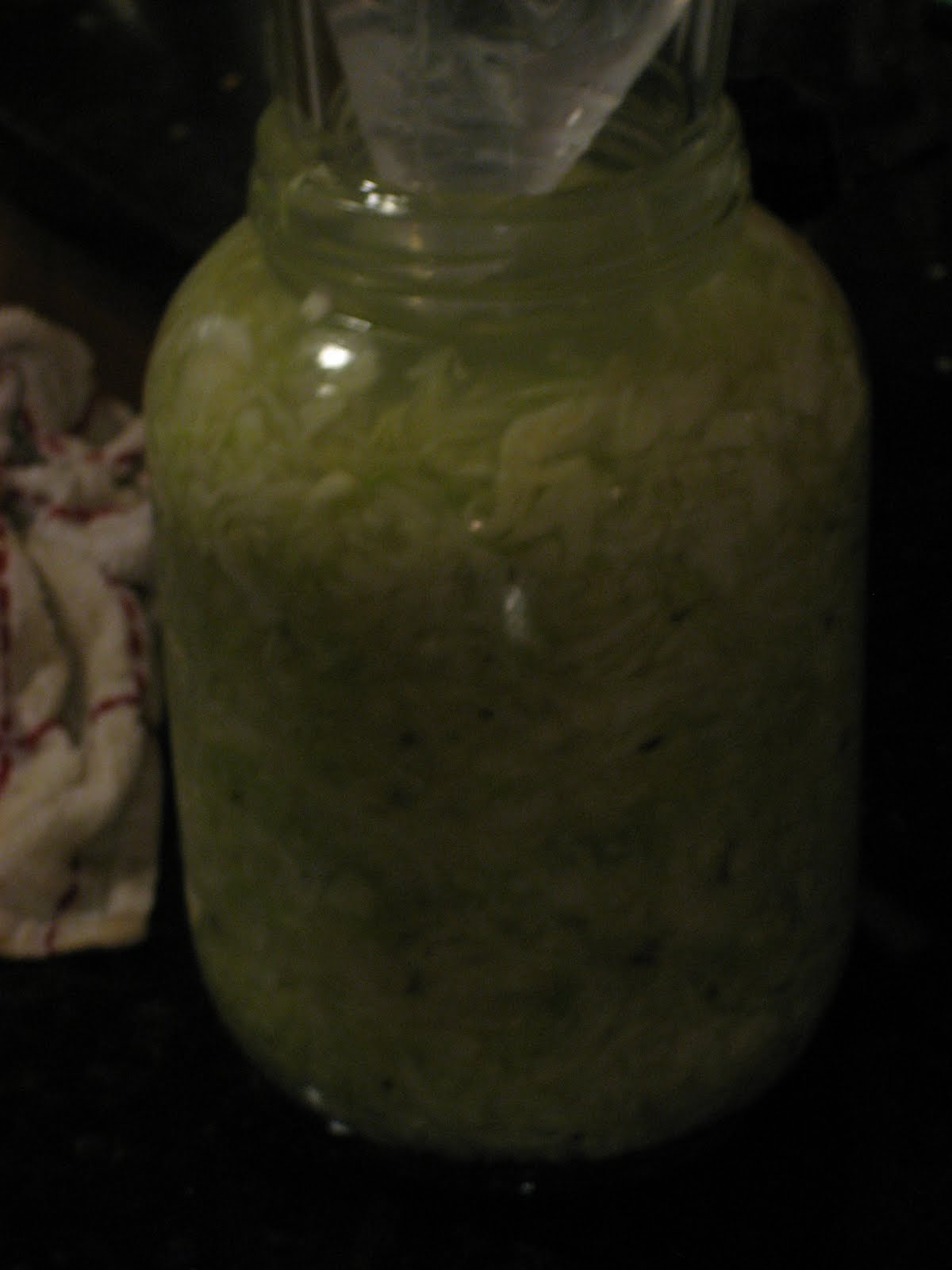
Sauerkraut is incredibly simple.   In fact, it is just cabbage and salt.  For this batch, I threw in some juniper berries and caraway seeds to spice things up.

I used one and a half large heads of green cabbage, which yielded a bit under five useable pounds (I think) after I had removed damaged leaves and cored the heads.  By far the most difficult part of the process is shredding the cabbage really fine - this is where a kraut board, which is basically a huge mandoline comes in.  Of course, I don't have one, so I just chopped away.

Once the cabbage was shredded, I tossed it with:

3 tablespoons salt,
1 tablespoon whole juniper berries (which I picked in New Mexico)
and 1 tablespoon caraway seeds


Once everything is mixed together, place in a jar or crock of the appropriate size and weight with a plastic bag filled with water, or, as I eventually did, a glass full of water which happened to fit the jar perfectly.  The cabbage should release enough water to cover itself in brine, but if it doesn't, add extra brine with 1.5 tablespoons of salt for each quart of water.  I found that I had to add brine periodically because water would evaporate off, although I didn't use quite so much salt since I figured the salt was getting left behind anyway.


At 70-75 degrees, the cabbage will take 2-4 weeks to fully ferment and at 60 degrees it will take 5-6 weeks.  I let mine ferment for about 3 weeks, then capped the jar and put it in the fridge, where it still is.  When it's ready, the cabbage will be completely white, and will no longer be producing bubbles.

I haven't gotten to eat this with a hot dog or sausage yet, but it has been a pretty tasty addition to a few sandwiches.  Need to get some sausages though.

Also, the sauerkraut will smell pretty bad while it's fermenting.  Be warned.  I wasn't.