I had my first real mushroom hunting success of the season this weekend. In addition to ¾ of a pound of chanterelles, I found about ¼ pound of boletes, a decent-sized coral mushroom and a huge fruiting of pale jelly fungus that I have not yet been able to identify. There were a good number of other, less interesting species also fruiting, and some rather abundantly.
Can you see the chanterelles?
Here they are, ready for cleaning:
They were scattered in two areas about 20 feet apart. As you see, they are fairly small and a kind of buff color. I also found two very small, bright golden chanterelles that were a little ways off. I’m not sure if they were fruiting separately or were a different color for some other reason. I left the smallest mushrooms in the ground on Saturday and came back for them on Sunday. Their 24-hour growth was detectable but not significant. I picked ½ a pound Saturday and the rest Sunday.
I also met a middle-aged Asian couple foraging in the area on Sunday who asked me for some guidance. I told them that the red-capped, yellow-pored boletes that are fruiting in the area are almost certainly edible, and that I had already eaten some with no issues. I also, perhaps foolishly, showed them where the chanterelles were fruiting so that they would know what it looks like. Probably too generous. The woman is holding out for oysters anyway, apparently. The man said that he had been told the coral mushroom I had is edible, which I already suspected was the case. He wasn’t sure about the jelly fungus, but he has heard that the edible “jew’s ear” grows in the area.
Here are the other mushrooms from Sunday (jelly not pictured):
I cooked the boletes I collected on Saturday and ate them with gorgonzola polenta. They are no King Bolete, but still have a nice taste.
The coral mushroom is kind of earthy with a nice, chewy texture. It is also extremely peppery when raw, less so when cooked. I think small raw pieces would be really good in a salad.
I sautéed the second batch of boletes with the coral mushroom and ate them with cream and some pasta.
Monday, June 28, 2010
Tuesday, June 22, 2010
Sauerkraut
I actually made this a couple months ago, but didn't have the pictures on my computer until this week.
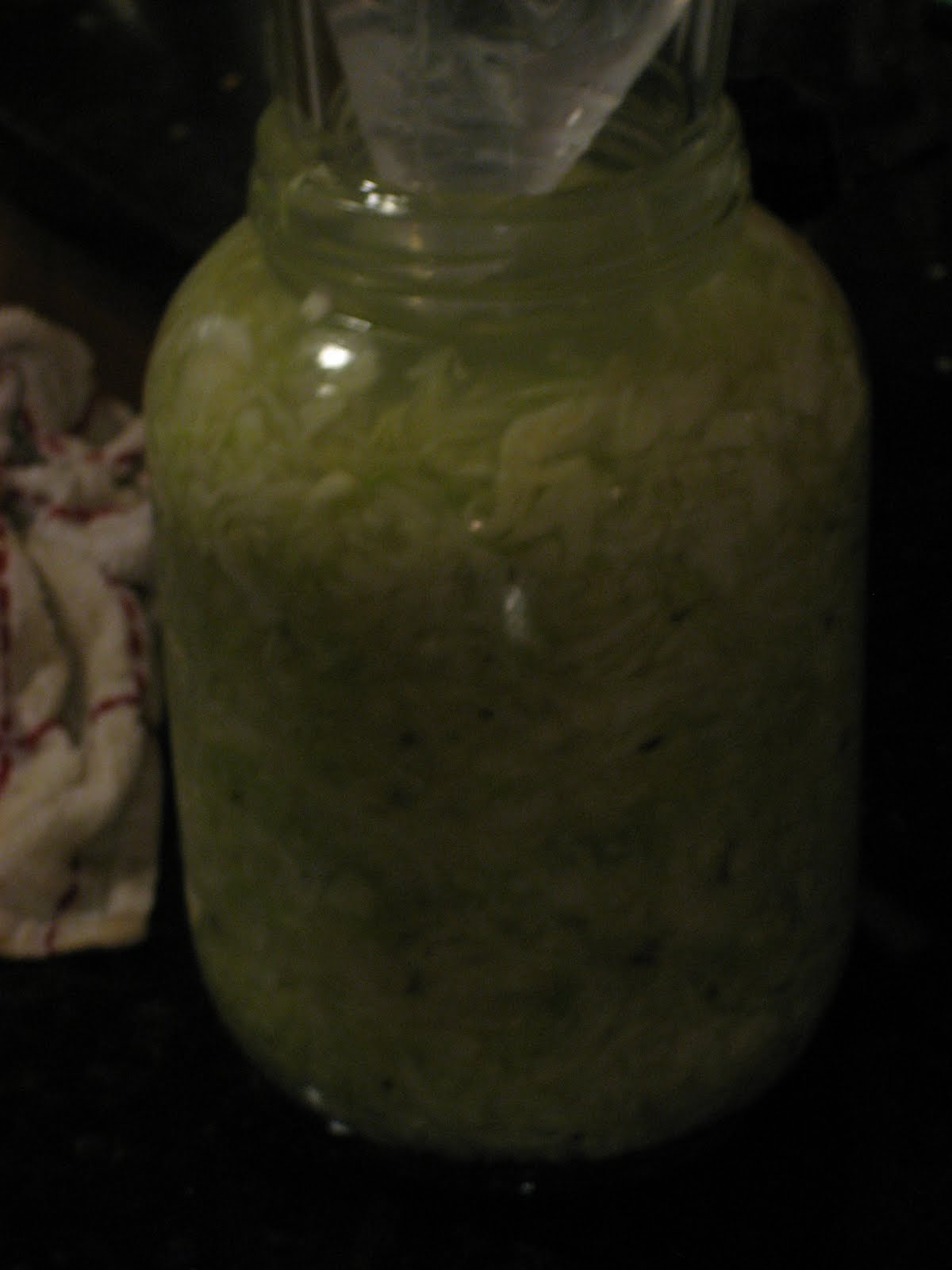
Sauerkraut is incredibly simple. In fact, it is just cabbage and salt. For this batch, I threw in some juniper berries and caraway seeds to spice things up.
I used one and a half large heads of green cabbage, which yielded a bit under five useable pounds (I think) after I had removed damaged leaves and cored the heads. By far the most difficult part of the process is shredding the cabbage really fine - this is where a kraut board, which is basically a huge mandoline comes in. Of course, I don't have one, so I just chopped away.
Once the cabbage was shredded, I tossed it with:
3 tablespoons salt,
1 tablespoon whole juniper berries (which I picked in New Mexico)
and 1 tablespoon caraway seeds

Sauerkraut is incredibly simple. In fact, it is just cabbage and salt. For this batch, I threw in some juniper berries and caraway seeds to spice things up.
I used one and a half large heads of green cabbage, which yielded a bit under five useable pounds (I think) after I had removed damaged leaves and cored the heads. By far the most difficult part of the process is shredding the cabbage really fine - this is where a kraut board, which is basically a huge mandoline comes in. Of course, I don't have one, so I just chopped away.
Once the cabbage was shredded, I tossed it with:
3 tablespoons salt,
1 tablespoon whole juniper berries (which I picked in New Mexico)
and 1 tablespoon caraway seeds
Once everything is mixed together, place in a jar or crock of the appropriate size and weight with a plastic bag filled with water, or, as I eventually did, a glass full of water which happened to fit the jar perfectly. The cabbage should release enough water to cover itself in brine, but if it doesn't, add extra brine with 1.5 tablespoons of salt for each quart of water. I found that I had to add brine periodically because water would evaporate off, although I didn't use quite so much salt since I figured the salt was getting left behind anyway.
At 70-75 degrees, the cabbage will take 2-4 weeks to fully ferment and at 60 degrees it will take 5-6 weeks. I let mine ferment for about 3 weeks, then capped the jar and put it in the fridge, where it still is. When it's ready, the cabbage will be completely white, and will no longer be producing bubbles.
I haven't gotten to eat this with a hot dog or sausage yet, but it has been a pretty tasty addition to a few sandwiches. Need to get some sausages though.
Also, the sauerkraut will smell pretty bad while it's fermenting. Be warned. I wasn't.
Friday, June 18, 2010
City Shrooms
All of these mushrooms were harvested within half a mile of my home.
The first bunch of inky caps was growing in the grassy area around a tree on the sidewalk. The picture doesn't quite capture it, but the fatter ones were really quite large.
After cleaning them, I cut them in halves and quarters depending on their size. I then sauteed them in olive oil with coarsely chopped garlic. They released a lot of juice, most of which I poured off. I then added some peeled San Marzano tomatoes, capers and the reserved mushroom liquid. Tasty little sauce.
The first bunch of inky caps was growing in the grassy area around a tree on the sidewalk. The picture doesn't quite capture it, but the fatter ones were really quite large.
After cleaning them, I cut them in halves and quarters depending on their size. I then sauteed them in olive oil with coarsely chopped garlic. They released a lot of juice, most of which I poured off. I then added some peeled San Marzano tomatoes, capers and the reserved mushroom liquid. Tasty little sauce.
The next bunch were also inky caps, but smaller, whiter and a little more firm. The picture below of the last handful shows how dirty they were. They were growing under and around a bush and I harvested them after a rain so it was a bit muddy.
All cleaned up.
Cooked them up with butter, some sliced onion and chopped garlic. When they were pretty well cooked, I added cream and a good amount of gorgonzola, then when everything was melted in, tossed with spaghetti.
Monday, May 24, 2010
Pizza Party Redux
First you gotta make your dough. I was inspired by this recent recipe/article in the NY Times to give sour dough crust another try. Unfortunately, the writer lost me at "using your fingers, break the starter dough into 1 inch pieces." I still don't know what that's about and I don't feel like finding out. So I did it my own way, roughly following the proportions in the recipe and using about 3/4 farina 00 and 1/4 all-purpose flour. I let the dough sit for about 8 hours then dividied into 4 pieces, which rose for another 24+ hours on the counter covered with saran wrap.
Because my starter was going crazy - presumably celebrating its longest stretch out of the fridge since the fall - I made some more dough at the same time that I separated the original batch into individual balls. For this one, I used only all-purpose flour, not knowing if I would be using it for pizza or just a loaf. In the end this dough was also called into service; you can read about the results below.
Next, you gotta make the cheese. Here are a couple of snaps of the almost-mozz sitting in whey. The cheese came out pretty firm again. I think next time I'm going to let the curd reduce down slowly in simmering whey rather than kneading, which seems to squeeze all the juice out.

Because my starter was going crazy - presumably celebrating its longest stretch out of the fridge since the fall - I made some more dough at the same time that I separated the original batch into individual balls. For this one, I used only all-purpose flour, not knowing if I would be using it for pizza or just a loaf. In the end this dough was also called into service; you can read about the results below.
Next, you gotta make the cheese. Here are a couple of snaps of the almost-mozz sitting in whey. The cheese came out pretty firm again. I think next time I'm going to let the curd reduce down slowly in simmering whey rather than kneading, which seems to squeeze all the juice out.
Pizza Time
Number One: a two-cheese white pizza topped off with prosciutto di parma and arugula. The cheeses were: a delicious aged chevre from Capriole's stand at the farmer's market and a strong Italian blue made from buffalo milk.
Number Two: a combination of crimini, oyster and portobello mushrooms with tomato sauce, mozzarella and basil.
Number Three: a three-cheeser with my mozzarella added to the chevre and blue, tomato sauce and prosciutto only on half the pie. This one got the arugula treatment as well. Bit of trouble getting him in the oven, but delicious warts and all.
Number Four: portobello and roasted red pepper with mozz and aged chevre topped with basil.
Number Five: another three cheeser. Notice the puffier crust. This was the first of the two pies made with the second dough. I don't know if the driving factor in the difference between the doughs was in the flour-mix or the condition of the starter when they were made, but I suspect the latter. My starter literally puffed several inches out of its jar twice during the 16 hours before I made the second dough, while it was significantly tamer in the run-up to the first. The dough itself was also considerably more active during its 24 hour rise. Lesson learned is that the starter really needs to stretch its legs after coming out of the fridge. There is a real balancing act for pizza though - these last pies had a great crispy-chewy texture and good char, but they were also noticeably sour, which is not always what I'm looking for in a pizza crust.
Number Six: finished off the portobello and red pepper with this one. Chevre and mozz again. Probably the most beautiful crust of the evening.
Thursday, May 13, 2010
Wild Garlic Molten Souffle, Elk, Raw Milk Mozzarella and Sour Dough
These pictures stretch back more than a month.
Molten souffle, with wild garlic and gruyere. Basically, this recipe, except with wild garlic. And also, too much egg - a miscommunication about adjusting the recipe's proportions. Still delicious, but a true gruyere would have taken it to another level. Bad stocking decision, Costco.
Folding the egg whites.
Forgot to smooth the top. You can sort of see that it's not solid in the middle.
Nothing wrong with bechamel, egg and cheese in liquid form.
Nothing wrong with elk and Steel Reserve either. Served with greens, aioli, cheddar, haricots verts, mushroom, green garlic and pine nuts.
I thought there were more pictures of the cheesemaking process, but this is all I've got. The cheese came out tougher than I would have liked - not a big deal when it's going in pizza, but disappointing. The flavor of the raw milk and the resulting mozzarella was very rich and grassy. Took some getting used to, but it grew on me a lot.
Pizza with sour dough crust, homemade mozz and foraged mushroom. I prefer non-sour dough crust, which is too dense in my opinion, but this was the only dough available.
This is where the sour dough is in its element. Awesome.
Sunday, May 2, 2010
Neptune: Bounty of the Sea
The greatness of a city emanates from its maritime bounty. A landlocked city knows not the moderate climate brought by the sea, nor does it require the spacial efficiency of the water-bound metropolis; it is free to sprawl and meander like a slowly spreading oil spill. It is the vigor of the sea, its constant lashings and lappings, that creates the urban culture necessary to drive its people towards worldly cosmopolitanism and its food towards excellence.
To celebrate the summer weather now blanketing DC, we paid a long-awaited visit to Maine Avenue Fish Market. DG and I thoroughly gorged ourselves last summer on a bounty of oysters on the half shell, steamed shrimp, crabs, and crayfish. This time, however, after a quick and prerequisite dozen oysters, my roommate and I made purchases for cooking rather than immediate consumption. To participate in a race to the bottom with the Japanese, we bought one pound of yellow-fin tuna. Following that, we turned to the crustaceans. One pound of scallops and a dozen oysters joined the mix. The piece(s)-de-resistance? 3 enormous and fully alive soft shell crabs (tis the season) and 4 of the biggest fresh-water shrimp to ever ply the azure seas. Seriously. These things were the size of lobster tails.
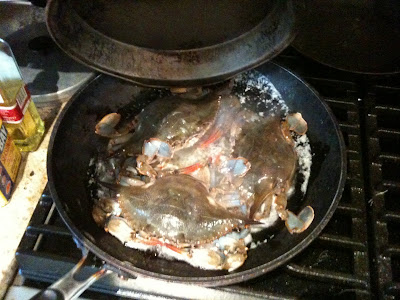
To prep this bounty, we armed ourselves with butter, parsley, and lemons. Grilled oysters were the first order of business, which meant nothing more than a hot charcoal fire, the clank of calcium-carbonate on grill grate, and the patience to see the shells gradually open. Concurrent to the oyster grilling, I prepared two pans indoors by melting a gang of butter. Into the bigger pan went the three still-alive crabs. Unlike the usual preparation, I did not dredge these puppies in flour. I instead opted to pan fry for about 5 minutes on each side. The end result, once topped with a hit of truffle oil, was sublime.
Finally, we threw the mega shrimp onto the heat and let them do their thing. I stuffed them with a bit of parsley and garlic which was basically unnecessary, the shrimp being incredibly sweet and the butter adding a salty richness to the party. Indonesia sure does know how to manufacture sea-protein. In the end, we gathered our bounty and presented it to Yahweh.
And an up close: grilled tomatoes and seared tuna on a bed of arugula, flanked by grilled oyster, sautéed scallop, and half of an ill soft shell crab. This was some serious effete gourmet shit.
To celebrate the summer weather now blanketing DC, we paid a long-awaited visit to Maine Avenue Fish Market. DG and I thoroughly gorged ourselves last summer on a bounty of oysters on the half shell, steamed shrimp, crabs, and crayfish. This time, however, after a quick and prerequisite dozen oysters, my roommate and I made purchases for cooking rather than immediate consumption. To participate in a race to the bottom with the Japanese, we bought one pound of yellow-fin tuna. Following that, we turned to the crustaceans. One pound of scallops and a dozen oysters joined the mix. The piece(s)-de-resistance? 3 enormous and fully alive soft shell crabs (tis the season) and 4 of the biggest fresh-water shrimp to ever ply the azure seas. Seriously. These things were the size of lobster tails.
To prep this bounty, we armed ourselves with butter, parsley, and lemons. Grilled oysters were the first order of business, which meant nothing more than a hot charcoal fire, the clank of calcium-carbonate on grill grate, and the patience to see the shells gradually open. Concurrent to the oyster grilling, I prepared two pans indoors by melting a gang of butter. Into the bigger pan went the three still-alive crabs. Unlike the usual preparation, I did not dredge these puppies in flour. I instead opted to pan fry for about 5 minutes on each side. The end result, once topped with a hit of truffle oil, was sublime.
On a pan next to these moulting wonders were 20 or so sea scallops. These were lightly sautéed in butter. My preparation was a bit imprecise and, as a result, they did not caramelize to a golden brown and instead remained a milky white. Hence, no picture. They were still alright, however scallops require more attention than I had at the time.
Doing work on the grill, my roommate began plucking one oyster after another from the heat. In their place went this beautiful tuna, lightly coated in soy, pickled ginger, and garlic. That's whats up.
Finally, we threw the mega shrimp onto the heat and let them do their thing. I stuffed them with a bit of parsley and garlic which was basically unnecessary, the shrimp being incredibly sweet and the butter adding a salty richness to the party. Indonesia sure does know how to manufacture sea-protein. In the end, we gathered our bounty and presented it to Yahweh.
And an up close: grilled tomatoes and seared tuna on a bed of arugula, flanked by grilled oyster, sautéed scallop, and half of an ill soft shell crab. This was some serious effete gourmet shit.
Monday, April 5, 2010
Wild Garlic
I went to the woods yesterday hoping to find morels, whose season, given the recent weather, has almost certainly begun in this part of Illinois. Alas, there were no morchella to be found. I was compensated, however, by a bounty of wild garlic, whose shoots spread widely over a large embankment beside a brook. Chicagua is not named Chicagua for nothing. A small portion of these were duly harvested by trowel and by hand, with bulbs attached and without. You can see the small bulbs and rootlets attached to some shoots on the left of the picture. I also collected several ramps, one of which is pictured in my hand. There were some more to be had, but between a degree of uncertainty as to their identification and the abundance of garlic nearby, they were foolishly left behind.
The garlic shoots are probably most similar to chives, very fresh tasting, but a little sharper and more garlicky. The ramps, which are well known in gourmet circles, but which I have never tasted, are very interesting. I think their flavor is usually described as some mixture of onion, garlic and leek, which is fair, but not really that helpful if you ask me. I would say they are delicious and unique.
Hopefully there will be some morels to post in the very near future. I am told that the clay-rich soil we saw yesterday, though ideal for garlic, is not conducive to the growth of morels (or probably any kind of mushroom). For the time being, I will be in search of sand and elm.
KB
Subscribe to:
Posts (Atom)